The Belgica expedition was above all a voyage of discovery to the Antarctic Peninsula where the crew found and mapped
a new passageway, the de Gerlache Strait, along the now commonly visited Antarctic Peninsula by touristic cruise ships.
The original aim of the expedition was to reach Cape Adare on the edge of West Antarctica, where they would leave
four crew members to over winter on the Antarctic continent. This did not happen.
The Belgian Adrien de Gerlache was the leader of the expedition which was funded by the Belgian government, Belgians
(through fares and donations) and various Belgian cities. It consisted of 19 people: 9 Belgians, 6 Norwegians, 2 Polish,
one Romanian and one American. It was a true international expedition! The young Roald Amundsen was among the
staff eager to learn about polar environments. He befriended the American doctor who was the official photographer
and who also monitored people’s health during the 13 months of entrapment in the sea ice, in particular the
Bellingshausen Sea. Cook had already obtained training in polar issues with eskimos in the northern hemisphere. Nearly
all members of the crew suffered from polar anaemia and Cook recommended a remedy for vitamin C deficiency by
eating raw meat of penguins and seals. This proved a success, and most crew members recovered. Cook and Amundsen
designed a new type of tent which later on Amundsen used during his venture to reach the South Pole.
The scientific achievements of the expedition was simply astonishing. The published results of the scientific discoveries
amounted to some 3,767 pages published over several decades after the expedition in the Belgian Government series
entitled “Memoirs of the S.Y. Belgica Expedition”. The scientific subjects span from meteorology, oceanography,
glaciology, geology, geophysics, biology (plants and animals). In total, some 2,645 pages described many aspects of
animal and plant life, all collected by the Romanian biologist Emil Ravovitza. Disappointingly, many aspects of the
published scientific observations have been ignored by the anglosaxon community, likely because most of the results
were published in French. In addition, today’s meteorologists and oceanographers have ignored all the Belgica findings
when discussing environmental changes in the Antarctic Peninsula region. Often the used baseline goes back to 1950!
Nevertheless, the Belgica data are so important when identifying changes over 125 years in the region. One example
being that the ship was trapped for over a year in the sea ice in the Bellingshausen Sea which today is ice free in the
austral summer. The question one can ask: ‘seals used to mate and bring their young on the sea ice, where do they live
today?’ Krill numbers are also diminishing substantially, and yet, they form a large part of the diet of many marine
mammals and the avifauna. A baseline with the Belgica data ought to be used. The Polish scientist Henryk Arctowski
collated air temperature data every hour, day and night, over 13 months while the ship was trapped. He also made 61
detailed observations of the aurora australis, and in addition collated temperature profiles for 60 sites that show a
significant change in near-surface temperatures in both Drake Passage (5 profiles) as well as in the Bellingshausen Sea
(17 profiles). One memoir displays the first-ever published photographs of whales.
I spent several years examining Belgica archives in Belgium , Norway, Poland, Romania, and the US in order to compile
them into a book entitled: “The Belgica expedition 1897-1899. The first expedition to winter in Antarctic waters. A tale
of extraordinary scientific achievements and human endurance”. It consists of 296 pages with some 190 illustrations,
mostly in colour (many of the black and white photographs have been ‘colourised’), plus 10 pages of references, nearly
all of scientific nature.
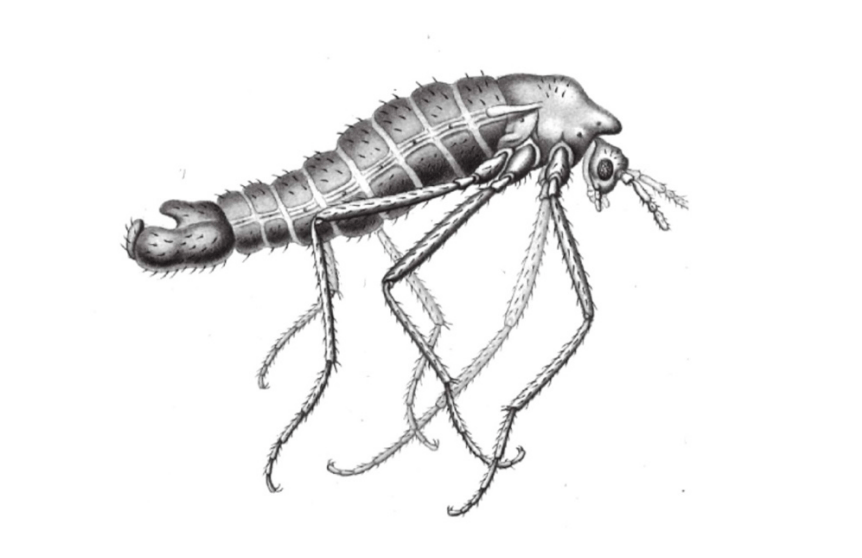
Image one: Original drawing of the very small (2=6 mm) flightless Belgica antarctica discovered by E. Racovitza and
described by J.-Ch. Jacobs the Belgian entomologist-medical doctor in 1900. Perhaps this insect exemplifies the Belgica
expedition as ‘it is able to survive in harsh and very cold environments.’ Over 100 scientific papers have so far been
published on this extraordinary midge.
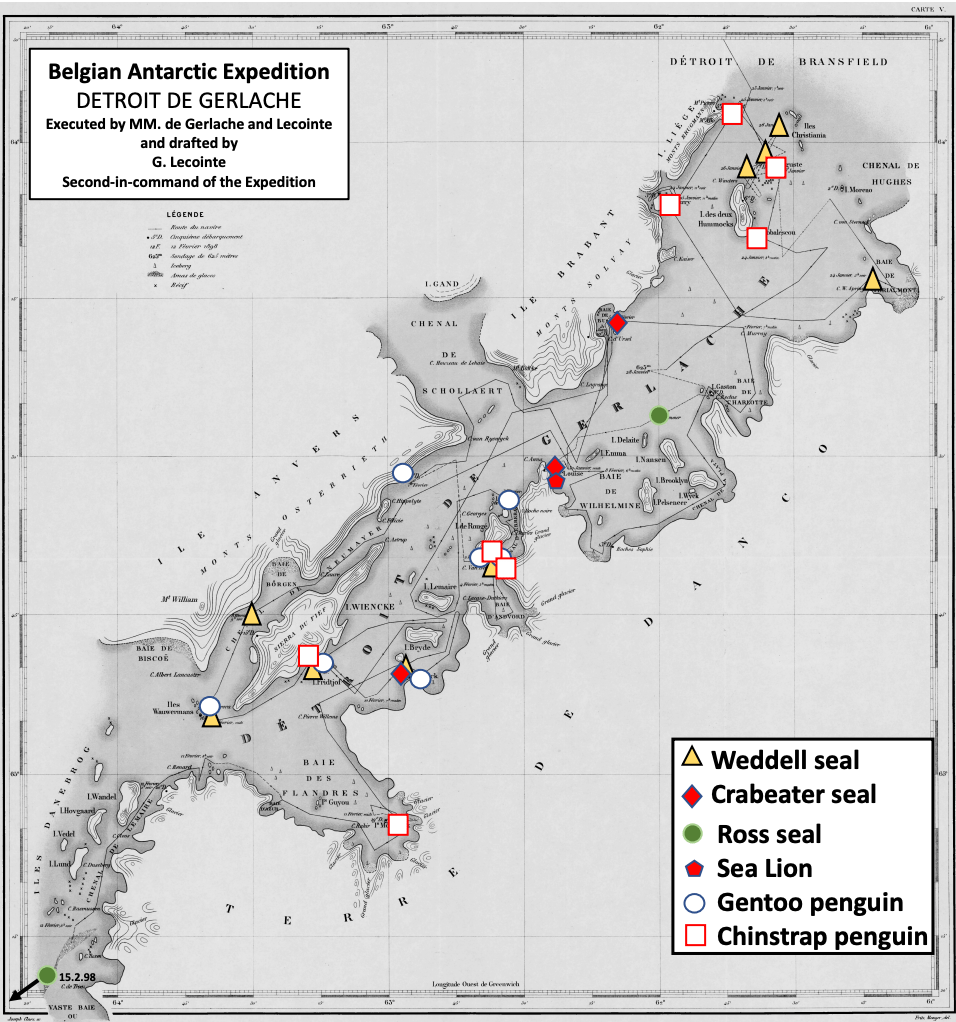
Image two: Map showing the route taken by the Belgica expedition in de Gerlache Strait (map made in 1898 over 20
days only) and the location of where four seal species were found as well as two species of penguins were seen during
the expedition This is the first-ever map published for this area showing the sightings of seals and penguins that could
be used to check today’s distribution of those sea animals.
 <strong>Belgica Expedition</strong>